Most faculty development programs measure success by two things: attendance and feedback scores. How many people showed up. How many rated it four stars or above.
The AI Faculty Transformation Lab measures success by something different. What you carry out of the room.
The Lab is a 14-week online program. One live session per week. A moderated LMS environment that holds your work between sessions. A cohort of faculty from institutions across India who are asking the same hard question: is what I am doing in the classroom still fit for the world my students are entering?
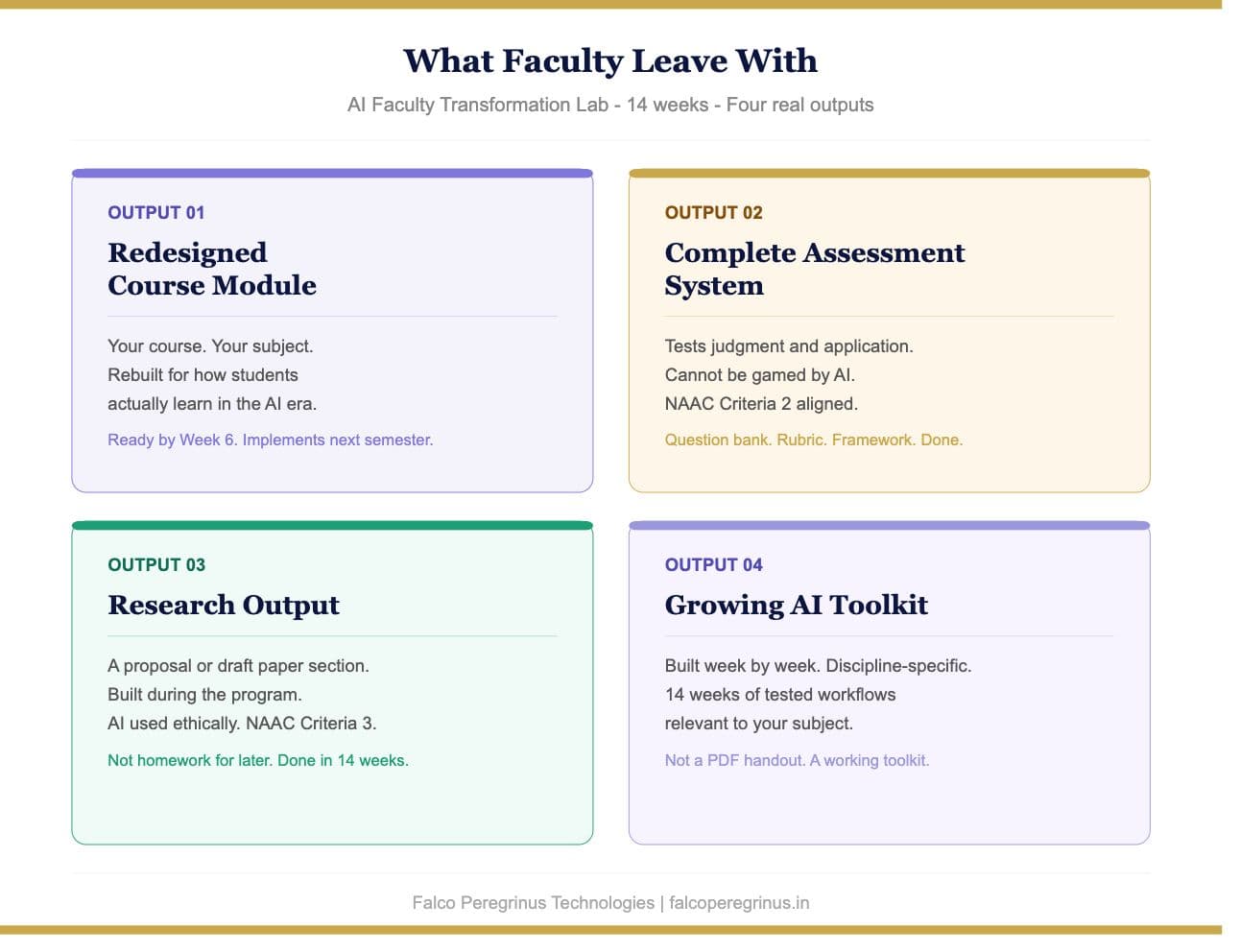
By the end of 14 weeks, every participant leaves with four things. Not certificates. Not slides. Work.
Output 1: A Redesigned Course Module
Not a template. Not a framework someone else designed. Your course. Your subject. Rebuilt.
In Segment 1: Understanding the Shift - participants begin by reviewing one existing course they teach. They identify the gaps. Not theoretical gaps. Specific ones. Where are students using AI to bypass thinking rather than enhance it? Where does the course design assume a world that no longer exists?
In Segment 2: Teaching Design - the rebuilding begins. The shift is from lecture-led delivery to structured learning experiences. Engagement mechanisms that AI cannot shortcut. A course flow redesigned so that thinking happens inside it, not around it.
By Week 6, participants have a module that is ready to implement in the next semester. Not homework for later. Done during the program.
Output 2: A Complete Assessment System
This is the output most faculty identify as most urgently needed.
The problem with most assessment in Indian higher education today is not that it is bad. It is that it was designed before AI existed as a tool students could access. An assessment designed to test recall is now an assessment that any student with a phone can pass without understanding anything.
In Segment 3: Assessment Design - participants rebuild assessment from the ground up. Application-based questions. Case-based scenarios. Evaluation rubrics that test judgment, not reproduction. Continuous assessment models that reduce dependence on a single high-stakes examination.
Participants leave with an assessment framework for one complete course, a higher-order question bank, an evaluation rubric, and the ability to build the next one independently.
This output directly supports NAAC Criteria 2 - Teaching-Learning and Evaluation. The assessment system built during the Lab is not just better pedagogy. It is evidence. Universities looking to generate this evidence automatically throughout the year can explore how CaseCrumbs™ and SustAInSkills™ make that possible.
Output 3: A Research Output
A research proposal or a draft paper section. Built during the program. Not assigned as homework.
In Segment 4: Research Workflows Reimagined - participants work on their actual research. They define a research problem using AI-assisted literature review. They structure their methodology. They draft a section of a paper or build a complete research proposal.
The focus throughout is academic integrity. AI as a thinking partner, not a ghost-writer. The distinction matters and it is built into how the segment is designed.
Faculty who are also PhD supervisors find this segment particularly valuable. The frameworks for using AI ethically in research are the same frameworks their doctoral scholars need. Many leave with material they can share directly with the researchers they supervise.
This output supports NAAC Criteria 3 - Research, Innovations and Extensions - the same criteria that CaseCrumbs™ and SustAInSkills™ address at the institutional level.
Output 4: A Growing AI Toolkit
This is the output that surprises participants most.
It is not a PDF of prompts handed out on Day 1. It is not a list of tools that will be outdated in six months. It is a discipline-specific, personally curated set of AI workflows built, tested and refined across 14 weeks of real work.
Every week, as participants work through the program, they discover and document what actually works in their subject. A Chemistry professor builds a different toolkit from a Law faculty member. A Civil Engineering professor works with different AI patterns from someone in Literature.
By Week 14 each participant has 14 weeks of tested, subject-specific AI workflows. Prompts that work in their discipline. Research tools that fit their methodology. Assessment design patterns that suit their course structure.
This is not a starter kit. It is a working toolkit built by the participant, for their context, across the full duration of the program.
Week 14: Capstone and Consolidation
The final week brings everything together. Participants present their redesigned course and assessment to the cohort. They refine based on peer feedback. They leave with a complete, consolidated body of work across all four outputs.
The cohort matters here. By Week 14 participants have spent 13 weeks working alongside faculty from different disciplines, different institutions, different teaching contexts. The diversity of the cohort is by design. It forces clarity about one's own discipline when explaining it to someone who teaches something completely different.
The Standard
The Lab does not measure success by how many people attended each session. It measures success by one question: did this faculty member leave with work they can implement?
Not knowledge. Not inspiration. Work.
If a faculty member completes 14 weeks and goes back to their classroom doing exactly what they did before the program has failed. That is the standard.
About the AI Faculty Transformation Lab
The Lab is designed and led by KRV Raja Subramanian - professor, former Dean at BITS Pilani, former Founder-Director of the Myanmar Institute of Information Technology, and author of three books on Generative AI in education.